Showing posts with label baseball cards. Show all posts
Friday, May 13, 2011
A Tribute to Harmon Killebrew
This installment of the Card of the Week (or not quite a week) features the 1975 Topps Harmon Killebrew card, number 640 in the set. The 1975 Topps set was noted for it's two color frame around the photos, a radically different look than the previous sets had. It was almost as though Topps was trying to cash in on having drugged up people look at the card borders and have strange trips.
The reason for the card, and Killebrew in particular, is actually a melancholy one. This card was actually the final card produced by Topps during his playing career, and it feels like a fitting tribute to this great player. Killebrew, as some of you may not have heard, was battling esophageal cancer. Now, at age 74, he has decided to end his battle, and is settling into hospice care to live out the rest of his days.
Killebrew, even when looking at the inflated numbers of the steroid era, still rates as one of the top sluggers in baseball history. His 573 home runs ranks 11th on the all-time list, just behind Mark McGwire. His eight seasons with 40 or more home runs is second all-time, trailing only Babe Ruth. He also made 11 All-Star games, and won an MVP award in 1969.
Killebrew was known as a humble, gentle person, whose nickname of 'Killer' was the furthest possible from his way of being. When asked about his nickname once, Killebrew said "I didn't have evil intentions, but I guess I did have power." With 573 career homers, there is no guesswork as to how much power he truly had.
Sunday, March 6, 2011
Card of the Week Part 7 - 1921 Exhibit Babe Ruth
This week, the featured card is the 1921 Exhibit Babe Ruth. Exhibit produced a litany of various cards, focusing on the pop culture of the time. Their cards ran the gamut of topics, from sports to entertainers to fighter planes and even Benito Mussolini and strippers (seriously). From 1921, when Exhibit began it's foray into the trading card business, to 1971, it is estimated that they produced over 14000 different cards on various topics.
Exhibit, not being a tobacco or candy company, had a different way of distributing these cards. As most people during that time frame went to bars or amusement parks for entertainment, they created a card dispencing machine, the sole purpose of which was to sell these cards. This was significant for the time, as previously cards, regardless of topic, were intended as a secondary piece of advertising. For Exhibit, the cards were the purpose.
The card featured is the Babe Ruth from the inagural set. Unlike most items featuring Ruth, this one has him in a fielding position, which is exceedingly rare. Notice how he seems to be staring off into the distance, even as his body is, theoretically, facing the field of play. Yet, even dispite his seeming nonchelance towards fielding being captured for all time, Ruth was a solid fielder for his time. In 1921, he had a .966, which was actually .006 higher than the league average. Over his career, his defensive wins above replacement, which compares a player to the league average, finished at a positive 7.4. All in all, Ruth was not a liability in the field of play.
This is a very rare card, with a very rare image of Ruth, capturing a skill that he still had, but was not considered as noteworthy as his prodigious power. Exhibit did quite well to use this as the picture for this set.
Sunday, February 13, 2011
Card of the Week Part 5 - 1972 Topps Joe Morgan Traded
The Topps Traded sets as we have come to know them originally came about in 1981, when a separate boxed set featuring players that were traded during the season, and rookies that did not make the base set, was introduced. Previously, there had been other incarnations of the Traded set, both in 1974 and 1976, as 44 card sets featuring only players that had been traded. However, the origins of this concept trace their way back to 1972.
Included as part of the high numbered section of the set, this seven card subset featured well known players who had been traded during the season. These cards featured those players in their new uniforms, with a facsimile rubber stamp saying 'Traded' angled across the bottom of the card. At the time, this was a novel concept, as it required getting to the player on the new team, getting the photograph, and having the card ready in time for inclusion in that series. Back before the internet, digital photography, and the technology of today, this was a difficult undertaking.
Joe Morgan, who is on the card depicted, was traded from Houston to Cincinnati along with four other players for Lee May, Tommy Helms, and Jimmy Stewart. May was a solid player, coming off of back to back All-Star appearances, while Helms and Stewart were serviceable players at the major league level. Morgan, however, became one of the vital cogs of the Big Red machine of the 1970's, going on to make eight consecutive All-Star Game appearances, win back to back MVP awards, and win four Gold Gloves at second base. He also helped to lead the Reds to the post season five times, winning two World Series.
Sunday, January 30, 2011
Card of the Week - Part 3
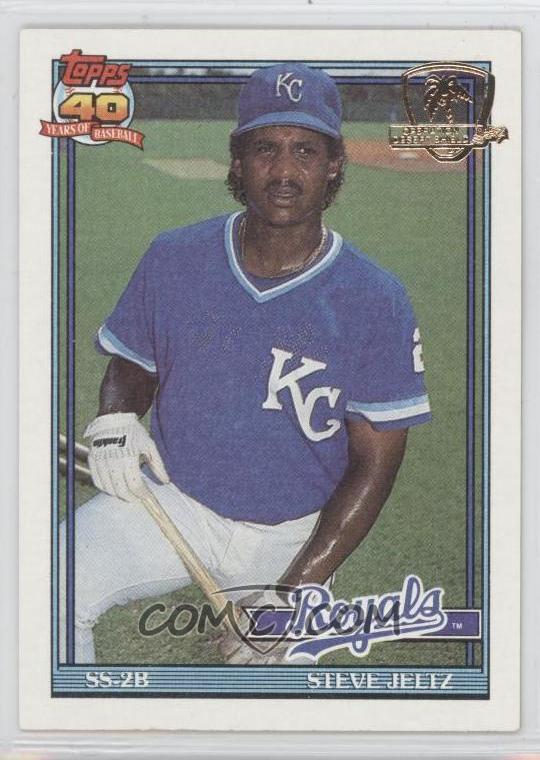
This week's 'Card of the Week' is actually a set: the 1991 Topps Desert Shield set. This set was a parallel to the basic 1991 Topps set, and was given distributed in pack form to the troops serving in the Desert Shield campaign. The difference is in the foil stamp in the upper right hand part of the card.
These cards are extremely rare, holding one of the highest multipliers in terms of value for any Topps set. As such, they were prone to counterfeiting. The best way to tell whether or not the Desert Shield card is genuine is to examine the foil stamp itself. The real logo is silver and does not shine brightly. The counterfeits have a stamp that is almost gold in color, and extremely bright. To get around this, people online tend to darken the photos, this way the foil stamp seems closer to the silver of the legitimate cards.
The Steve Jeltz card depicted is simply an example of the cards from the set. Yes, I fully admit to picking this card due to being a Royals fan and this being the first Royals player I located. All in all, this is an interesting set, not only due to the scarcity of the cards, but due to the historical context of the first war in Iraq.
Sunday, January 23, 2011
Card of the Week - Part 2
This week's Card of the Week (hopefully a weekly series as the title would suggest) is the 1987 Topps Ben Oglivie. The 1987 set was a nod towards the classic 1962 Topps set, as the wood grain borders and the overall design would suggest. Measuring 792 cards in total, the set also included the rookie cards of Barry Bonds, Barry Larkin, Bo Jackson, and Rafael Palmiero.
1986 was the final season in Oglivie's career. Spanning from 1971 until 1986, he amassed 1615 hits, 235 home runs, and 901 RBI to go along with a .273 career batting average. A three time All-Star, he also won a Silver Slugger award in 1980, the same year that he lead the American League with 41 home runs.
So, why this card? Oglivie was a solid, but rather unremarkable player over his career. Well, it's simple. People always remember their firsts in life - first love, first kiss, first concert, first pet. This card was the first baseball card I ever got, being the top card in a pack of 1987 Topps purchased by me so long ago.
As collections and thoughts change, it can all be traced back to the appropriate first. This card, depicting Oglilvie as he appears to be thinking back fondly upon a solid career, kickstarted my enjoyment of collecting. Hopefully somewhere, you still have the item that brought you to whatever brought you into the hobby that you enjoy.
Thursday, January 13, 2011
Card of the Week - Part 1
Above is the Shoeless Joe Jackson bat card from 2001 SP Legendary Cuts. The card was a part of the Debut Game Bat set, featuring players who had yet to have a game used card produced.
The card has an interesting history. As Jackson was banned from Major League Baseball due to his alleged involvement with the 1919 Black Sox scandal, he was not able to be on any cards licensed by Major League Baseball or the Player's Union. As such, this card ended up being pulled from production, making it a difficult card to locate.
Jackson was also a very good player, and one that would have ended up in the Hall of Fame had he not be banned. He left baseball with the third highest all-time batting average at .356. He had a career total of 1772. However, he is best known for his alleged role with the Black Sox, a matter that he was found innocent after a trial in 1921. Despite this, the commissioner of baseball, Judge Kenesaw Mountain Landis, banned him and the other seven players, stating that baseball needed to clean up it's image.
Jackson's tale is rather tragic, and this card, and the history surrounding it, reinforces the absurdity of his suspension.
Subscribe to:
Comments (Atom)