Every so often, when researching statistics in baseball, one happens to come along a season or a player that makes you wonder exactly what happened at that time frame. While looking into various statistics on an outfielder named Gavvy Gravath who played from 1908 until 1920, I noticed that he had several seasons with an extremely high adjusted OPS+. In 1913, his adjusted OPS+ was 172. He then followed this season by producing seasons in 1914 and 1915 with an OPS+ of 161 and 171, respectively. As such, I got curious as to where these ranked as the highest over the course of a season.
For those that don't know, adjusted OPS+ is OPS adjusted for the park and the league in which the player played, but not for fielding position. An OPS+ of 100 is defined to be the league average. An OPS+ of 150 or more is excellent and 125 very good, while an OPS+ of 75 or below is poor. OPS is determined by adding on base percentage and slugging percentage. As such, in the sabermetric community, it is regarded as an extremely useful tool to determine the value of a hitter.
When looking over the leaders in OPS+ for a season, the top three marks are held by Barry Bonds, which should not come as a surprise. In fact, most of the top ten is filled by Bonds, Babe Ruth (five through seven) and Ted Williams (eight and nine). However, in fourth place, is a player by the name of Fred Dunlap, who in 1884 posted an OPS+ of 258. This record actually stood until 2001, when Bonds passed it with a mark of 259. Here is a link to the list from baseballreference.com: http://www.baseball-reference.com/leaders/onbase_plus_slugging_plus_season.shtml
Dunlap, nicknamed 'Sure Shot' due to his strong throwing arm, was 25 in 1884. That season, for the Saint Louis Maroons of the shortly lived Union Association, he managed to hit .412 with a .448 OBP. He led the league in hitting, OBP, slugging (.621), home runs (13), hits (185), and runs (160). These statistics were compiled over 101 games, in an era when the mounds stood fifty feet from home plate and an overhand throwing motion was considered legal for the first time. Still, this was nominally a part of the dead ball era, so these statistics were extremely impressive, especially for a second baseman.
With a sport such as baseball, where the history of the game is as much of the present and future than with any other sport, it can be quite enlightening to go through and look through some of the season leader lists. Prior to Bonds constant intentional walks and power surge, it seemed quite unlikely that this record would have been broken, yet no one realized that it existed. For all those that state that DiMaggio's 56 game hitting streak is unapproachable or that there will never be another .400 hitter, there's no guarantee. It did take 118 years for someone to pass Fred Dunlap after all.
Thursday, March 3, 2011


Wednesday, March 2, 2011
Best sign yet for football in 2011
In a ruling that signaled a major blow to the NFL, US District Judge David Doty agreed with the NFLPA in regards to the NFL receiving $4billion in television revenue, regardless of whether or not football was played this upcoming season. In his decision, Doty stated that the NFL violated it's agreement with the NFLPA, stating that "The record shows that the NFL undertook contract renegotiations to advance its own interests and harm the interests of the players."
By having the television contracts set up in such a way where the NFL, and the various teams, would be paid whether or not a football game was played, the owners guaranteed that a lockout would happen, especially when they had an out clause in the previous collective bargaining agreement. After all, why would someone pay the players to perform when they can just shut the gates and turn a profit?
Lost in all of this is that the players WANT to be playing football in 2011. The biggest issues are that the owners want a bigger piece of the revenue pie, and they want 18 games so that they can 'give the fans what the fans want'. However, amongst people that identify themselves as NFL fans, only 45% are even slightly in favor of the change, and a mere 18% strongly favor it. So, in other words, 82% of NFL fans don't want it, or are lukewarm at best to the concept.
Furthermore, expanding the NFL season to 18 games will further decrease the future health, and length of career, for the players. However, this does not seem to matter to a commissioner and a league that continually talks about 'player safety'. If they are so concerned with the future health of the players, why are they trying to expand the season under a flimsy excuse to disguise their profit motives? Why do they continue to promote and market DVDs of defenseless players getting blown up? Hypocrites.
Hopefully this ruling will force the hand of the NFL and the commissioner, so that there will be a season in 2011. With the NFL being at the apex of it's popularity, why risk a disruption over a few million dollars? It's short sighted, reckless, and hazardous to a sport that has become the most watched in the nation. Should a lockout actually occur, it will be interesting to see how the league recovers - if it does at all.
By having the television contracts set up in such a way where the NFL, and the various teams, would be paid whether or not a football game was played, the owners guaranteed that a lockout would happen, especially when they had an out clause in the previous collective bargaining agreement. After all, why would someone pay the players to perform when they can just shut the gates and turn a profit?
Lost in all of this is that the players WANT to be playing football in 2011. The biggest issues are that the owners want a bigger piece of the revenue pie, and they want 18 games so that they can 'give the fans what the fans want'. However, amongst people that identify themselves as NFL fans, only 45% are even slightly in favor of the change, and a mere 18% strongly favor it. So, in other words, 82% of NFL fans don't want it, or are lukewarm at best to the concept.
Furthermore, expanding the NFL season to 18 games will further decrease the future health, and length of career, for the players. However, this does not seem to matter to a commissioner and a league that continually talks about 'player safety'. If they are so concerned with the future health of the players, why are they trying to expand the season under a flimsy excuse to disguise their profit motives? Why do they continue to promote and market DVDs of defenseless players getting blown up? Hypocrites.
Hopefully this ruling will force the hand of the NFL and the commissioner, so that there will be a season in 2011. With the NFL being at the apex of it's popularity, why risk a disruption over a few million dollars? It's short sighted, reckless, and hazardous to a sport that has become the most watched in the nation. Should a lockout actually occur, it will be interesting to see how the league recovers - if it does at all.
Tuesday, March 1, 2011
The Nets are setting themselves up
When a team has been terrible for an extended period of time, things need to change. Typically, this involves firing a coaching staff and/or a front office. Very rarely does the change come from the ownership, in terms of a dramatic new vision and dynamic for a team that is an afterthought, if anything at all. And let's face it, the New Jersey Nets have been an afterthought since they randomly won the Eastern Conference in 2002 and 2003.
However, this mindset began to change with the introduction of Mikhail Prokhorov as the new owner of the Nets. From the beginning, he had a vision - he wanted to build a team around a couple of transcendent players, he wanted to move the team to Brooklyn so as to better market the Nets brand, and he wanted to set the Nets up as a global team.
In purchasing the Nets, Prokhorov also personally funded a loan for $700 million to build their new arena in Brooklyn. The remainder of the funding would be acquired through the banking system, making it where the taxpayers of Brooklyn did not have to be taxed any further for the construction of another owner's private playground.
Next, Prokhorov set about revamping the front office and coaching staff with his goals in mind. He named a new general manager in Billy King, who had been the general manager of the Philadelphia 76ers from 1998 until 2007, and a new head coach in Avery Johnson, who had been the Coach of the Year for the Dallas Maverics in 2006, and had reached the NBA Finals previously. With a staff set, the Nets could now focus on gaining a legitimate superstar to build around.
With their impending move to Brooklyn, their primary target became Carmelo Anthony, a native of New York who wanted to play in front of his hometown crowds. However, he had no interest in playing for the Nets, and wisely, the Nets moved on, trading for a top three point guard in Deron Williams. Coupled with a burgeoning star at the center position in Brook Lopez, the future for the Nets on the court looks bright indeed.
Yet, their future off the court may be even better. With Prokhorov, the Nets are looking to expend themselves internationally, to be the franchise that fans in Europe, Africa, and Asia follow. Already, they have played the Toronto Raptors in London this year. They have a basketball clinic scheduled for Russia during the next offseason, and already played exhibition games in China. Add this to the amount of foreign born players on the nets roster, a Russian language website and a television deal to broadcast Nets games in Russia, there is a solid foundation. Yes, the NBA can limit what teams can do in terms of international promotion, but the Nets are on their way.
Perhaps this vision can save a franchise from falling to the ranks of irrelevancy, which is where teams like the Pacers or the Grizzlies find themselves. By focusing on areas outside their present neighborhood and to keep from spending their entire advertising budget in a futile attempt to wrestle away the stray Knicks fan, the Nets can legitimately make something of themselves, and tap into a fanbase that has been waiting for someone to pay attention to them.
Well played thus far Prokhorov. Hopefully this will translate into success.
However, this mindset began to change with the introduction of Mikhail Prokhorov as the new owner of the Nets. From the beginning, he had a vision - he wanted to build a team around a couple of transcendent players, he wanted to move the team to Brooklyn so as to better market the Nets brand, and he wanted to set the Nets up as a global team.
In purchasing the Nets, Prokhorov also personally funded a loan for $700 million to build their new arena in Brooklyn. The remainder of the funding would be acquired through the banking system, making it where the taxpayers of Brooklyn did not have to be taxed any further for the construction of another owner's private playground.
Next, Prokhorov set about revamping the front office and coaching staff with his goals in mind. He named a new general manager in Billy King, who had been the general manager of the Philadelphia 76ers from 1998 until 2007, and a new head coach in Avery Johnson, who had been the Coach of the Year for the Dallas Maverics in 2006, and had reached the NBA Finals previously. With a staff set, the Nets could now focus on gaining a legitimate superstar to build around.
With their impending move to Brooklyn, their primary target became Carmelo Anthony, a native of New York who wanted to play in front of his hometown crowds. However, he had no interest in playing for the Nets, and wisely, the Nets moved on, trading for a top three point guard in Deron Williams. Coupled with a burgeoning star at the center position in Brook Lopez, the future for the Nets on the court looks bright indeed.
Yet, their future off the court may be even better. With Prokhorov, the Nets are looking to expend themselves internationally, to be the franchise that fans in Europe, Africa, and Asia follow. Already, they have played the Toronto Raptors in London this year. They have a basketball clinic scheduled for Russia during the next offseason, and already played exhibition games in China. Add this to the amount of foreign born players on the nets roster, a Russian language website and a television deal to broadcast Nets games in Russia, there is a solid foundation. Yes, the NBA can limit what teams can do in terms of international promotion, but the Nets are on their way.
Perhaps this vision can save a franchise from falling to the ranks of irrelevancy, which is where teams like the Pacers or the Grizzlies find themselves. By focusing on areas outside their present neighborhood and to keep from spending their entire advertising budget in a futile attempt to wrestle away the stray Knicks fan, the Nets can legitimately make something of themselves, and tap into a fanbase that has been waiting for someone to pay attention to them.
Well played thus far Prokhorov. Hopefully this will translate into success.
Monday, February 28, 2011
Cam Newton - Future Bust
A lot of hype is coming out of the NFL Scouting Combine about Cam Newton. Interestingly, Newton has managed to bring this buzz to levels that are polar opposites of one another, with analysts saying that the Panthers or the Bills would be insane to pass him up with their first picks (picks one and three, respectively). Meanwhile, other analysts who watched the same workouts and heard the same answers given to questions ask if Newton isn't Akili Smith version 2011. Potential franchise QB to Akili Smith? Why the difference in opinion?
Looking at his time at the combine, we need to begin with a quote he said in an interview with Peter King of Sports Illustrated. When asked himself about how he sees himself, Newton responded with "I see myself not only as a football player, but an entertainer and icon." Interesting choice of words there. Especially since Newton is already going to be highly scrutinized given the off field incidents with his father setting up a 'pay for play' with him during the recruiting process. Yes, Cam was cleared of any knowledge or improper behavior through the situation, but this still deserves to be watched. Patterns can develop from issues such as these.
Then Newton took the field to throw at the combine. One word can describe his performance - disaster. Granted, he was throwing to unfamiliar targets, but everyone else that threw had the same disadvantages. In the end, he finished by completing only 11 of his 21 throws. He was frequently overthrowing his receivers, with the ball sailing on the ten yard out patterns, the fifteen yard in patterns, and the fly patterns specifically. He did hit the turnarounds, but this still raises enough questions about his accuracy and ability to hit a receiver. This dramatically paled in comparison to his performance previously in San Diego when he had a scheduled media workout on his terms. He did show a great arm and a nice spiral in getting the ball through ten to fifteen mile per hour winds, but he made four passes the entire time. One can't really put a lot of stock in four passes, regardless of the conditions.
In the end, Cam Newton seems to be more about concepts such as 'talent', 'potential', and 'size' (6'6", 250 lbs) than he is about his abilities and skills. At this point, Newton seems to be a project, nothing more. Yet, some team will fall in love with his arm, and draft him much higher than he should go, sending him down the Ryan Leaf, Akili Smith, and Art Schlichter. Throw in the possibility of off the field problems, and this quarterback prospect has more red flags than the Chinese government.
In the end, stay away from Cam Newton. Nothing good can come of this.
Looking at his time at the combine, we need to begin with a quote he said in an interview with Peter King of Sports Illustrated. When asked himself about how he sees himself, Newton responded with "I see myself not only as a football player, but an entertainer and icon." Interesting choice of words there. Especially since Newton is already going to be highly scrutinized given the off field incidents with his father setting up a 'pay for play' with him during the recruiting process. Yes, Cam was cleared of any knowledge or improper behavior through the situation, but this still deserves to be watched. Patterns can develop from issues such as these.
Then Newton took the field to throw at the combine. One word can describe his performance - disaster. Granted, he was throwing to unfamiliar targets, but everyone else that threw had the same disadvantages. In the end, he finished by completing only 11 of his 21 throws. He was frequently overthrowing his receivers, with the ball sailing on the ten yard out patterns, the fifteen yard in patterns, and the fly patterns specifically. He did hit the turnarounds, but this still raises enough questions about his accuracy and ability to hit a receiver. This dramatically paled in comparison to his performance previously in San Diego when he had a scheduled media workout on his terms. He did show a great arm and a nice spiral in getting the ball through ten to fifteen mile per hour winds, but he made four passes the entire time. One can't really put a lot of stock in four passes, regardless of the conditions.
In the end, Cam Newton seems to be more about concepts such as 'talent', 'potential', and 'size' (6'6", 250 lbs) than he is about his abilities and skills. At this point, Newton seems to be a project, nothing more. Yet, some team will fall in love with his arm, and draft him much higher than he should go, sending him down the Ryan Leaf, Akili Smith, and Art Schlichter. Throw in the possibility of off the field problems, and this quarterback prospect has more red flags than the Chinese government.
In the end, stay away from Cam Newton. Nothing good can come of this.
Sunday, February 27, 2011
Card of the Week Part 6 - 2010 Prestige Aaron Hernandez
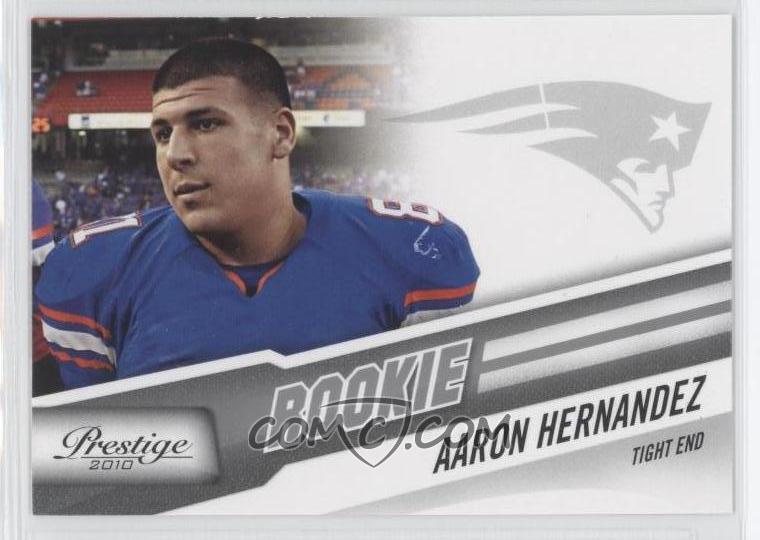
Above is the 2010 Panini Prestige Aaron Hernandez rookie card. This card was one of 104 rookie cards included in the base set (which included four cards not listed on the main checklist), and one of 26 different short prints. Panini has refused to announce a print run for the short prints in the set, or the odds to gettting one of the short prints in a box, so as to avoid placing an artifical cap on card values. Instead, they are relying on the secondary market and the principles of supply and demand to set prices.
Several of the rookies in the set have both a base card and a short printed draft variation. These include some of the bigger names in the 2010 draft, such as Tim Tebow, Sam Bradford, and Ndamukong Suh. Also, Gerald McCoy has two cards, both of which are short printed.
For a first time football set for a company known mainly for producing stickers, this was an excellent debut. Included in the 104 rookie cards were players who started to get more playing time and hobby love throughout the year, such as Blair White and James Starks. The rookies themselves are listed in alphabetical order by first name, with the exception of cards 301 through 304, which were not listed on the checklist that came with the box.
The Hernandez card is a great example for this set for a number of reasons. Not only is it the first rookie card on the checklist, but it is also the first short print. The set has a nice, crisp design, and does an excellent job with getting head shots of the rookies. At approximately $90 per box, with a total of four games used and/or autographs, this was a great product.
Wednesday, February 23, 2011
The NBA has a looming problem
In the wake of the Carmelo Anthony trade to the Knicks, a pattern has begun to develop. At this point, players have begun colluding amongst themselves, agreeing to play for a specific teams in order to build a few 'super teams'. Now, there is nothing illegal about this on the dies of the players, but if the owners were to get together in order to lower salaries, it would be a severe issue. Nothing quite like a double standard.
When did this all begin? In terms of athletes intentionally creating the 'super team' concept, it leads back to the Boston Celtics in the 2007-08 season, when Ray Allen and Paul Pierce pleaded with Kevin Garnett to join them in Boston. With the formation of the 'Big Three', the die had been cast.
Fast forward to this past off-season. LeBron, Dwayne Wade, and Chris Bosh meet several times, and decide to partner up in Miami to create their own Super Team, only their version is a younger, more dynamic group with three players entering their prime. It doesn't matter that the Heat no longer have anything resembling a surrounding cast to support them, as there was no longer any room under the cap. They have their version of the Big Three scoring roughly 68.6% of the team's points. The fourth leading scorer? Udonis Haslem, who is out for a long time at 8.0 points per game. Behind him? We find Eddie House at 6.9 points per.
Now, the New York Knicks are joining the party. After picking up Amare Stoudemire through free agency, they picked up Carmelo Anthony, who forced the Denver Nuggets to trade him. So who is the third piece? None other than Chris Paul, who joined Carmelo and Amare in toasting to playing together in New York during Carmelo's wedding. Paul happens to be a free agent after next season, so don't expect him to sign an extension in New Orleans.
The NBA is rapidly becoming a collection of the haves against the have nots. Why play in a place like Toronto or Sacramento, when you can force that team to deal you to a team like Miami or New York? Why attempt to build something in an area that truly enjoys basketball, but happens to be in the middle of nowhere? After all, image is so much more important than the game, right?
This is something that David Stern needs to look at during the collective bargaining agreement. The league may become nothing more than six to eight teams loaded with superstars, while the rest of the teams either have to fold or play in obscurity. A hard salary cap would help to fix this issue. So would creating a franchise type tag in the NBA. But regardless of what they determine the answer to be, this needs to be fixed. And soon.
When did this all begin? In terms of athletes intentionally creating the 'super team' concept, it leads back to the Boston Celtics in the 2007-08 season, when Ray Allen and Paul Pierce pleaded with Kevin Garnett to join them in Boston. With the formation of the 'Big Three', the die had been cast.
Fast forward to this past off-season. LeBron, Dwayne Wade, and Chris Bosh meet several times, and decide to partner up in Miami to create their own Super Team, only their version is a younger, more dynamic group with three players entering their prime. It doesn't matter that the Heat no longer have anything resembling a surrounding cast to support them, as there was no longer any room under the cap. They have their version of the Big Three scoring roughly 68.6% of the team's points. The fourth leading scorer? Udonis Haslem, who is out for a long time at 8.0 points per game. Behind him? We find Eddie House at 6.9 points per.
Now, the New York Knicks are joining the party. After picking up Amare Stoudemire through free agency, they picked up Carmelo Anthony, who forced the Denver Nuggets to trade him. So who is the third piece? None other than Chris Paul, who joined Carmelo and Amare in toasting to playing together in New York during Carmelo's wedding. Paul happens to be a free agent after next season, so don't expect him to sign an extension in New Orleans.
The NBA is rapidly becoming a collection of the haves against the have nots. Why play in a place like Toronto or Sacramento, when you can force that team to deal you to a team like Miami or New York? Why attempt to build something in an area that truly enjoys basketball, but happens to be in the middle of nowhere? After all, image is so much more important than the game, right?
This is something that David Stern needs to look at during the collective bargaining agreement. The league may become nothing more than six to eight teams loaded with superstars, while the rest of the teams either have to fold or play in obscurity. A hard salary cap would help to fix this issue. So would creating a franchise type tag in the NBA. But regardless of what they determine the answer to be, this needs to be fixed. And soon.
Monday, February 21, 2011
Perhaps this is part of the problem
Following the example of other athletes who spend money like water, or make it rain tens of thousands of dollars (I'm looking at you Pac-Man Jones), Bryant McKinnie managed to run up a $100,000 bar tab over the NBA All-Star weekend. This large sum was apparently spent on 15 bottles of champagne. This averages out to approximately $6666 per bottle. The champagne better contain liquid gold bullion for that money.
Keep in mind, the NFL is facing a potential lockout in the next few weeks. At that point in time, there won't be any paychecks forth coming. Whatever McKinnie has aside has now decreased by that $100,000. Judging by his lack of control with the ol' wallet, I'm guessing that amount isn't really a whole lot.
If he has any financial advisers, they will hopefully yank him aside and let him know that dropping money like that at this time is not a good idea. A lack of forethought on financial matters such as this works as an example as to how so many athletes end up broke within five years of leaving whatever league they're playing in. Just look at Antoine Walker, who is playing in the NBA Development League because he needs the money. He's broke after making over $100 million in his NBA career. In fact, fellow player Nazr Mohammed paid half of the fee for his bankruptcy attorneys. Then again, Mohammed and Walker have a history together, having been robbed together in January 2000 outside a Chicago restaurant, so these decisions seem to run together.
This mindset is why so many athletes struggle with their finances after their playing careers. I realize that they regard college as essentially a minor league for whatever sport they play, but maybe they should pay attention in class for once. It would save them in the long run.
Keep in mind, the NFL is facing a potential lockout in the next few weeks. At that point in time, there won't be any paychecks forth coming. Whatever McKinnie has aside has now decreased by that $100,000. Judging by his lack of control with the ol' wallet, I'm guessing that amount isn't really a whole lot.
If he has any financial advisers, they will hopefully yank him aside and let him know that dropping money like that at this time is not a good idea. A lack of forethought on financial matters such as this works as an example as to how so many athletes end up broke within five years of leaving whatever league they're playing in. Just look at Antoine Walker, who is playing in the NBA Development League because he needs the money. He's broke after making over $100 million in his NBA career. In fact, fellow player Nazr Mohammed paid half of the fee for his bankruptcy attorneys. Then again, Mohammed and Walker have a history together, having been robbed together in January 2000 outside a Chicago restaurant, so these decisions seem to run together.
This mindset is why so many athletes struggle with their finances after their playing careers. I realize that they regard college as essentially a minor league for whatever sport they play, but maybe they should pay attention in class for once. It would save them in the long run.
Monday, February 14, 2011
Man up LeBron James
For the third time in as many meetings, the Boston Celtics defeated the Miami Heat yesterday. Despite a game where Paul Pierce scored only one point and missed all of his field goal attempts, the Celtics managed to find a way to win. This follows a pattern that has come into play since the trio of Pierce, Allen, and Garnett were put together three years ago, where, despite the situation, they fight and claw to the last moment.
Meanwhile, Miami does not have the same killer, or championship, mentality that the Celtics have. With an opportunity to tie the game, LeBron missed his first free throw. As soon as the pressure was off, he promptly sank the second shot. Granted, it is just one free throw attempt, but this is a microcosm of what LeBron has become. At this point, he looks for excuses as to why the losses happen, instead of taking charge and trying to will his teams to victory.
From the moment LeBron and Chris Bosh signed in Miami, they were anointed as the NBA Champions, even though a game had yet to be played. They staged a 'meeting' with the players, where they came out on a smoke filled stage and preened for the adoring crowds. They expected that all they would have to do would be to show up, and they would win not just one championship, but the multiples that LeBron promised. Well, it's not so easy when other teams stand up.
Thus far, LeBron has claimed that Miami "doesn't have the chemistry that the Celtics have." When the Big Three in Boston first came together, they won 29 of their first 32 games. They deferred to each other. They worked hard at all aspects of the game. They would not back down to anyone. LeBron and the Heat? It's just excuse after excuse as they try to disguise how mentally soft they really are.
After the game, Dwayne Wade attempted to compare the Heat's struggles against the Celtics to how Michael Jordan and the Chicago Bulls had issues with the Detroit Pistons in the late 1980's. There are, however, several major differences. First, Jordan had nowhere near the supporting cast that LeBron has in Miami. Scottie Pippen was a good player, but he was not in the class of a Dwayne Wade. Those Bulls teams never had a player the caliber of Chris Bosh. They had solid players supporting an all time great, not three perennial All-Stars.
Second, Jordan refused to let up. He would win, or he would go to the last second trying to get that victory. Nothing mattered more to him than to win at everything he tried. With LeBron, it's about image. It's about his brand. It's about having fun. Then maybe basketball factors in after those three things.
Third, Jordan loved the pressure. He created some of the most memorable moments in NBA history during the playoffs. LeBron, meanwhile, shrinks from the pressure. He passes up shots. He commits turnovers he normally wouldn't make. The shots he does take, he misses more than he hits. LeBron simply does not have the mental fortitude required to be the leader of a championship team.
As such, it is time for LeBron James to man up. He needs to realize that nothing is being handed to him in Miami, and that he needs to work at getting championships. Otherwise, his legacy is going to be about unfulfilled potential and all the excuses made for him.
Meanwhile, Miami does not have the same killer, or championship, mentality that the Celtics have. With an opportunity to tie the game, LeBron missed his first free throw. As soon as the pressure was off, he promptly sank the second shot. Granted, it is just one free throw attempt, but this is a microcosm of what LeBron has become. At this point, he looks for excuses as to why the losses happen, instead of taking charge and trying to will his teams to victory.
From the moment LeBron and Chris Bosh signed in Miami, they were anointed as the NBA Champions, even though a game had yet to be played. They staged a 'meeting' with the players, where they came out on a smoke filled stage and preened for the adoring crowds. They expected that all they would have to do would be to show up, and they would win not just one championship, but the multiples that LeBron promised. Well, it's not so easy when other teams stand up.
Thus far, LeBron has claimed that Miami "doesn't have the chemistry that the Celtics have." When the Big Three in Boston first came together, they won 29 of their first 32 games. They deferred to each other. They worked hard at all aspects of the game. They would not back down to anyone. LeBron and the Heat? It's just excuse after excuse as they try to disguise how mentally soft they really are.
After the game, Dwayne Wade attempted to compare the Heat's struggles against the Celtics to how Michael Jordan and the Chicago Bulls had issues with the Detroit Pistons in the late 1980's. There are, however, several major differences. First, Jordan had nowhere near the supporting cast that LeBron has in Miami. Scottie Pippen was a good player, but he was not in the class of a Dwayne Wade. Those Bulls teams never had a player the caliber of Chris Bosh. They had solid players supporting an all time great, not three perennial All-Stars.
Second, Jordan refused to let up. He would win, or he would go to the last second trying to get that victory. Nothing mattered more to him than to win at everything he tried. With LeBron, it's about image. It's about his brand. It's about having fun. Then maybe basketball factors in after those three things.
Third, Jordan loved the pressure. He created some of the most memorable moments in NBA history during the playoffs. LeBron, meanwhile, shrinks from the pressure. He passes up shots. He commits turnovers he normally wouldn't make. The shots he does take, he misses more than he hits. LeBron simply does not have the mental fortitude required to be the leader of a championship team.
As such, it is time for LeBron James to man up. He needs to realize that nothing is being handed to him in Miami, and that he needs to work at getting championships. Otherwise, his legacy is going to be about unfulfilled potential and all the excuses made for him.
Sunday, February 13, 2011
Card of the Week Part 5 - 1972 Topps Joe Morgan Traded

The Topps Traded sets as we have come to know them originally came about in 1981, when a separate boxed set featuring players that were traded during the season, and rookies that did not make the base set, was introduced. Previously, there had been other incarnations of the Traded set, both in 1974 and 1976, as 44 card sets featuring only players that had been traded. However, the origins of this concept trace their way back to 1972.
Included as part of the high numbered section of the set, this seven card subset featured well known players who had been traded during the season. These cards featured those players in their new uniforms, with a facsimile rubber stamp saying 'Traded' angled across the bottom of the card. At the time, this was a novel concept, as it required getting to the player on the new team, getting the photograph, and having the card ready in time for inclusion in that series. Back before the internet, digital photography, and the technology of today, this was a difficult undertaking.
Joe Morgan, who is on the card depicted, was traded from Houston to Cincinnati along with four other players for Lee May, Tommy Helms, and Jimmy Stewart. May was a solid player, coming off of back to back All-Star appearances, while Helms and Stewart were serviceable players at the major league level. Morgan, however, became one of the vital cogs of the Big Red machine of the 1970's, going on to make eight consecutive All-Star Game appearances, win back to back MVP awards, and win four Gold Gloves at second base. He also helped to lead the Reds to the post season five times, winning two World Series.
Friday, February 11, 2011
Ray Allen's Fraudulent Record
Last night, Ray Allen passed Reggie Miller's mark for most three point shots hit in a career, with 2561. Over his illustrious career, Allen has been a remarkable shooter. From pure aesthetics and touch, there have been few equals. For his fifteen year career, he has hit on roughly 40% of his three point attempts, 89% of his free throws, and 45% of his shots in general.
Of the shots taken by Allen over his career thus far, roughly 38% of them have come from beyond the three point arc. This is a player who, despite his obvious skills shooting the ball, has made his livelihood from over twenty feet from the rim. Breaking down his three point attempts per game, Allen averages just a shade under six (5.98) three point attempts per.
Now, he obviously has done his part to reach this record, by not only attempting the second most three point shots in NBA history, but also by hitting at a prodigious rate. His 39.8% success rate ranks 38th all time amongst those with a minimum of 250 three pointers attempted. However, there is a major flaw with this 'record' - namely that the three point shot didn't even exist in the NBA until the 1979-80 season.
For the first few years, the three point shot was not a major staple of a team's offense. From 1979-80 until 1986-87, the most three pointers attempted in a season was 257 by Darrell Griffith in 1984-85. In fact, he also had the second most attempts during that era as well, with 252 the previous season. However, in the late 1980's and the early part of the 1990's, teams began to use the shot with more frequency, leading to a time now where players are routinely taking 500 or more three pointers over a season. In fact, Allen had taken 653 three pointers during the 2005-06 season alone.
Also, the distance of the three point line has been subject to change. From 1994 until 1997, the line was set to be 22' feet from the basket at every point, as opposed to the 22' feet from the corners and 23'9" that it had been previously at the top of the key. The original dimensions were restored during the 1997-98 season, but several 'records' for three point shots had been established by the line change: George McCloud attempted 678 threes during the 1995-96 season, and Dennis Scott hit 267 threes that year as well. Allen broke Scott's record during his 2005-06 year.
When thinking back on some of the players who were in the NBA prior to the three point shot, it's interesting to think what they would have done had it existed. For example, Oscar Robertson, Jerry West, Elvin Hayes, and Pete Maravich didn't get to play their entire careers with this shot, and all were excellent shooters. Would the record be the same if they had the three point line back then?
Yes, this is a great feat that Ray Allen has accomplished. But it cannot truly be considered a record without having everyone on the same playing field.
Of the shots taken by Allen over his career thus far, roughly 38% of them have come from beyond the three point arc. This is a player who, despite his obvious skills shooting the ball, has made his livelihood from over twenty feet from the rim. Breaking down his three point attempts per game, Allen averages just a shade under six (5.98) three point attempts per.
Now, he obviously has done his part to reach this record, by not only attempting the second most three point shots in NBA history, but also by hitting at a prodigious rate. His 39.8% success rate ranks 38th all time amongst those with a minimum of 250 three pointers attempted. However, there is a major flaw with this 'record' - namely that the three point shot didn't even exist in the NBA until the 1979-80 season.
For the first few years, the three point shot was not a major staple of a team's offense. From 1979-80 until 1986-87, the most three pointers attempted in a season was 257 by Darrell Griffith in 1984-85. In fact, he also had the second most attempts during that era as well, with 252 the previous season. However, in the late 1980's and the early part of the 1990's, teams began to use the shot with more frequency, leading to a time now where players are routinely taking 500 or more three pointers over a season. In fact, Allen had taken 653 three pointers during the 2005-06 season alone.
Also, the distance of the three point line has been subject to change. From 1994 until 1997, the line was set to be 22' feet from the basket at every point, as opposed to the 22' feet from the corners and 23'9" that it had been previously at the top of the key. The original dimensions were restored during the 1997-98 season, but several 'records' for three point shots had been established by the line change: George McCloud attempted 678 threes during the 1995-96 season, and Dennis Scott hit 267 threes that year as well. Allen broke Scott's record during his 2005-06 year.
When thinking back on some of the players who were in the NBA prior to the three point shot, it's interesting to think what they would have done had it existed. For example, Oscar Robertson, Jerry West, Elvin Hayes, and Pete Maravich didn't get to play their entire careers with this shot, and all were excellent shooters. Would the record be the same if they had the three point line back then?
Yes, this is a great feat that Ray Allen has accomplished. But it cannot truly be considered a record without having everyone on the same playing field.
Subscribe to:
Posts (Atom)